Proxied records
What is reverse proxy?
A reverse proxy is a server that sits in front of one or more web servers, intercepting requests from clients. This is different from a forward proxy, where the proxy sits in front of the clients. With a reverse proxy, when clients send requests to the origin server of a website, those requests are intercepted at the network edge by the reverse proxy server. The reverse proxy server will then send requests to and receive responses from the origin server. Once again, let’s illustrate by naming the computers involved:
-
D: Any number of users’ home computers
-
E: This is a reverse proxy server
-
F: One or more origin servers
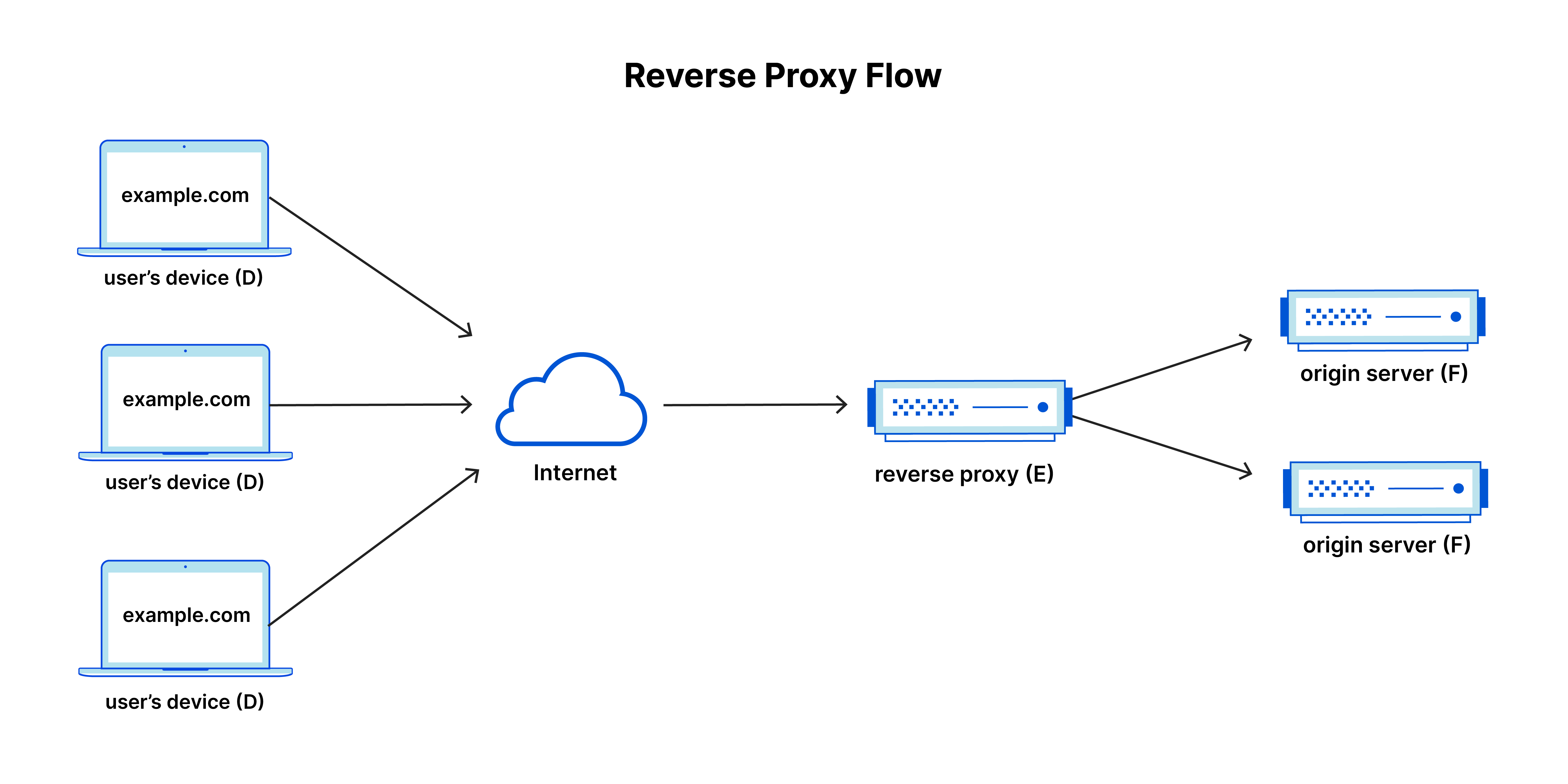
Typically all requests from D would go directly to F, and F would send responses directly to D. With a reverse proxy, all requests from D will go directly to E, and E will send its requests to and receive responses from F. E will then pass along the appropriate responses to D.
Below we outline some of the benefits of a reverse proxy:
- Load balancing - A popular website that gets millions of users every day may not be able to handle all of its incoming site traffic with a single origin server. Instead, the site can be distributed among a pool of different servers, all handling requests for the same site. In this case, a reverse proxy can provide a load balancing solution which will distribute the incoming traffic evenly among the different servers to prevent any single server from becoming overloaded. In the event that a server fails completely, other servers can step up to handle the traffic.
- Protection from attacks - With a reverse proxy in place, a web site or service never needs to reveal the IP address of their origin server(s). This makes it much harder for attackers to leverage a targeted attack against them, such as a DDoS attack. Instead the attackers will only be able to target the reverse proxy, such as Cloudflare’s CDN, which will have tighter security and more resources to fend off a cyber attack.
- Global server load balancing (GSLB) - In this form of load balancing, a website can be distributed on several servers around the globe and the reverse proxy will send clients to the server that’s geographically closest to them. This decreases the distances that requests and responses need to travel, minimizing load times.
- Caching - A reverse proxy can also cache content, resulting in faster performance. For example, if a user in Paris visits a reverse-proxied website with web servers in Los Angeles, the user might actually connect to a local reverse proxy server in Paris, which will then have to communicate with an origin server in L.A. The proxy server can then cache (or temporarily save) the response data. Subsequent Parisian users who browse the site will then get the locally cached version from the Parisian reverse proxy server, resulting in much faster performance.
- SSL encryption - Encrypting and decrypting SSL (or TLS) communications for each client can be computationally expensive for an origin server. A reverse proxy can be configured to decrypt all incoming requests and encrypt all outgoing responses, freeing up valuable resources on the origin server.
Proxied records
Note that if you have multiple A/AAAA records on the same name and at least one of them is proxied, Cloudflare will treat all A/AAAA records on this name as being proxied.
When you proxy specific DNS records through Cloudflare - specifically A, AAAA, or CNAME records — DNS queries for these will resolve to Cloudflare Anycast IPs instead of their original DNS target. This means that all requests intended for proxied hostnames will go to Cloudflare first and then be forwarded to your origin server.
Visitor <--Connection--> Cloudflare global network <--Connection--> Origin server
This behavior allows Cloudflare to optimize, cache, and protect all requests to your application, as well as protect your origin server from DDoS attacks.
Because requests to proxied hostnames go through Cloudflare before reaching your origin server, all requests will appear to be coming from Cloudflare’s IP addresses (and could potentially be blocked or rate limited). If you use proxied records, you may need to adjust your server configuration to allow Cloudflare IPs.
Cloudflare Anycast IPs used to proxy traffic on your domain are assigned automatically. These IPs might change at any time for operational reasons. If you need to allowlist Cloudflare IPs on your infrastructure or hosting provider, include the full list of Cloudflare Anycast IPs
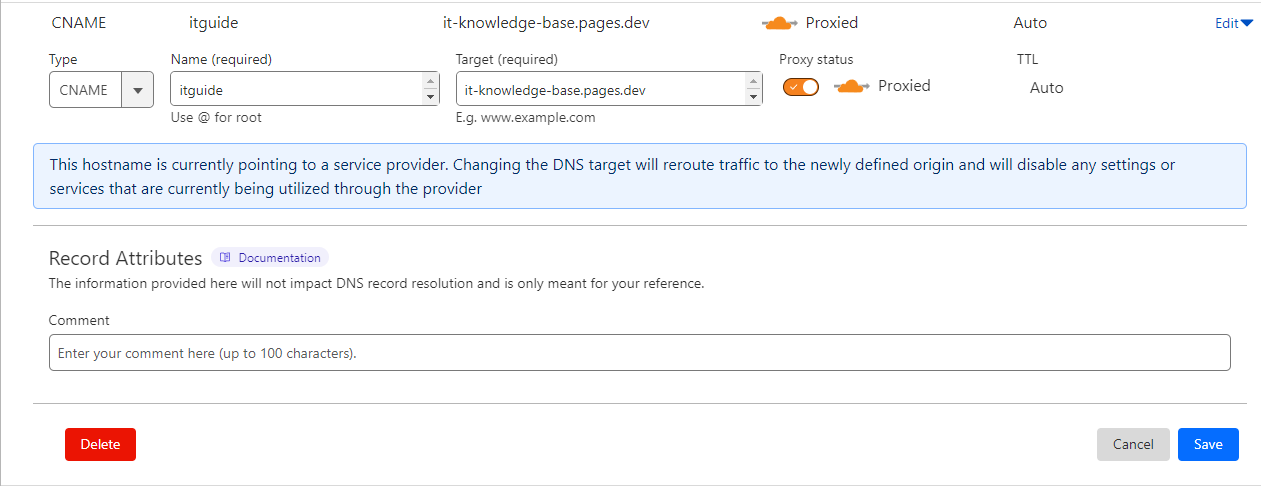
DNS-only records
When an A, AAAA, or CNAME record is DNS-only — also known as being gray-clouded — DNS queries for these will resolve to the record’s normal IP address.
Note that if you have multiple A/AAAA records on the same name and at least one of them is proxied, Cloudflare will treat all A/AAAA records on this name as being proxied.
In addition to potentially exposing your origin IP addresses to bad actors and DDoS attacks, leaving your records as DNS-only means that Cloudflare cannot optimize, cache, and protect requests to your application or provide analytics on those requests.